- Home
- Lifestyle
- The art of living in Provence
- Marc CHAGALL in Gordes
Marc CHAGALL in Gordes
#Chagall #painting #art #Gordes #Luberon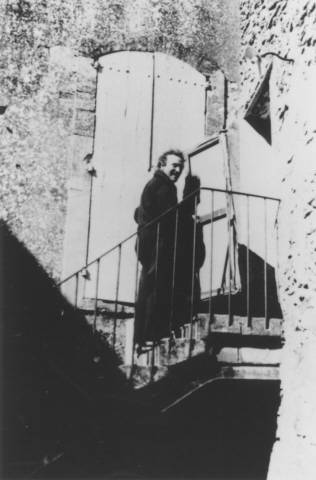
Chagall in Gordes
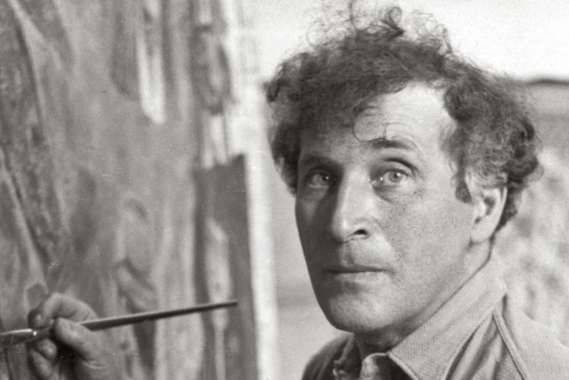
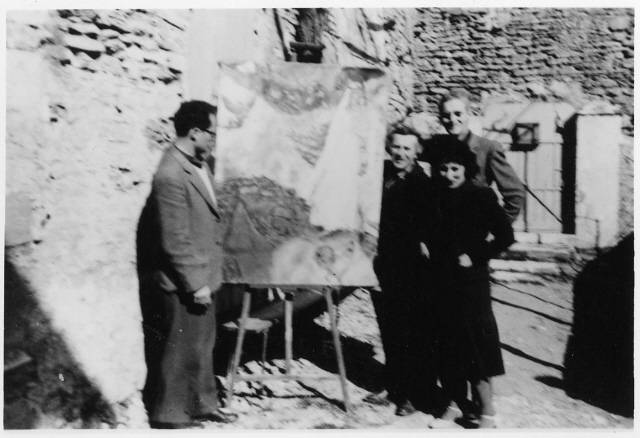
Of Jewish origin, Marc Chagall and his family tried to escape Nazism by seeking refuge in Gordes, where his friend, the painter André Lhote, was living. In 1940, Chagall lived in the « quartier fontaine basse » area of Gordes, in a seventeenth century house attached to a mill. He painted very little during this terrible era.
In 1941, he is arrested in Marseille. The US General Council invites him to New York, saving him from a terrible fate. He boards a boat to the United States with an invitation from the Museum of Modern Art in New York and spends the rest of the war there.
Chagall had an eventful life but Gordes stayed in his memory. Seduced, he came back to Gordes from time to time with his wife and daughter.
Chagall, the daydreamer
Chagall's work can be characterised as unclassifiable in a period marked by strong artistic trends and he remains remarkable throughout the twentieth century.
Sometimes approaching surrealism, it is simply a retranscription full of imagery of the life of a man, tinged with a more mystical than religious connotation. Imbued with joy, defined by misty colours, the work that foreshadows neorealism, reaches its pinnacle in the aftermath of the Second World War when abstract expressionism dominates the art scene.
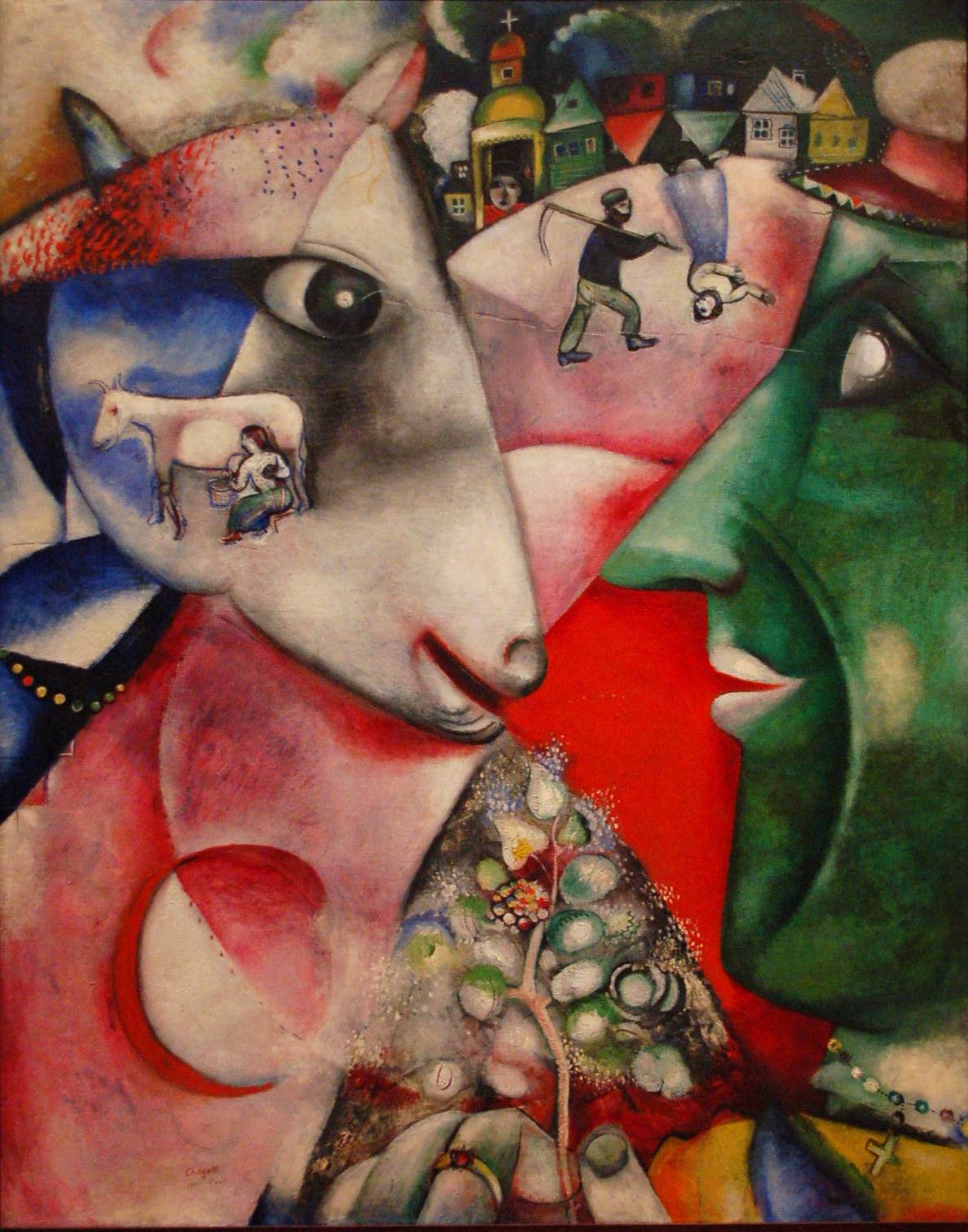
Chagall is a "daydreamer" and his brush, the weapon of the dream of the night. His work is known as "dreamlike chromaticism”, his rich palette of earthy colours so imprisons a dream just waiting to escape that the term dream-master may be used.
Each of his paintings is a hymn to joy, in a reinterpretation of the Hasidic Jewish tradition where every living being (man and animal alike) is involved in an almost pagan religious celebration.
Chagall’s artistic expression is plural. If the master has distinguished himself in his painting, he has also achieved fame in sculpture, book illustration and even mosaics. Despite this diversity, the painter's work remains universal and recognisable among all others by its unclassifiable style. "The poet," as his artist friends liked to call him, is a wonderful storyteller, oozing magic and marvels with an underlying melancholy. The perfect work is a pretext to evoke the bygone past, idealised by a lost childhood. This shows itself via an omnipresent symbolism in all his paintings.
Chagall scatters tracks throughout his creations and gives his observers clues that are repeated from one canvas to another and create a final unit. Each of his paintings echoes another, each work refers to another. The theme of childhood is ubiquitous and shows through constantly. A childhood that Chagall cherishes above all in that it evokes a bright future tinged with raw emotions: if only time could suspend its flight and the ingenuity of childhood remain forever.
Ideally, his work should be viewed as a dreamlike novel that would make any subtraction impossible to read, like having an alphabet primer before reading the master. Learning Chagall is like practising scales.
Chagall’s reference is quite simply his own life, especially the first part of his life before an enforced exodus forced him to live in his memories. The interpretation of the present moment will always result from his own experience, his own culture. His multiple artistic innovations are only used for the permanent reinterpretation of his memories. Chagall draws from his roots and offers the world values that are meant to be resolutely universal, this communion with the spectator. This position is unchanging and determines its creation. Just like the simple happiness that he will transform in each of his paintings in response to a pervasive anti-Semitism, but also to ward off personal tragedies (the death of his wife Bella).
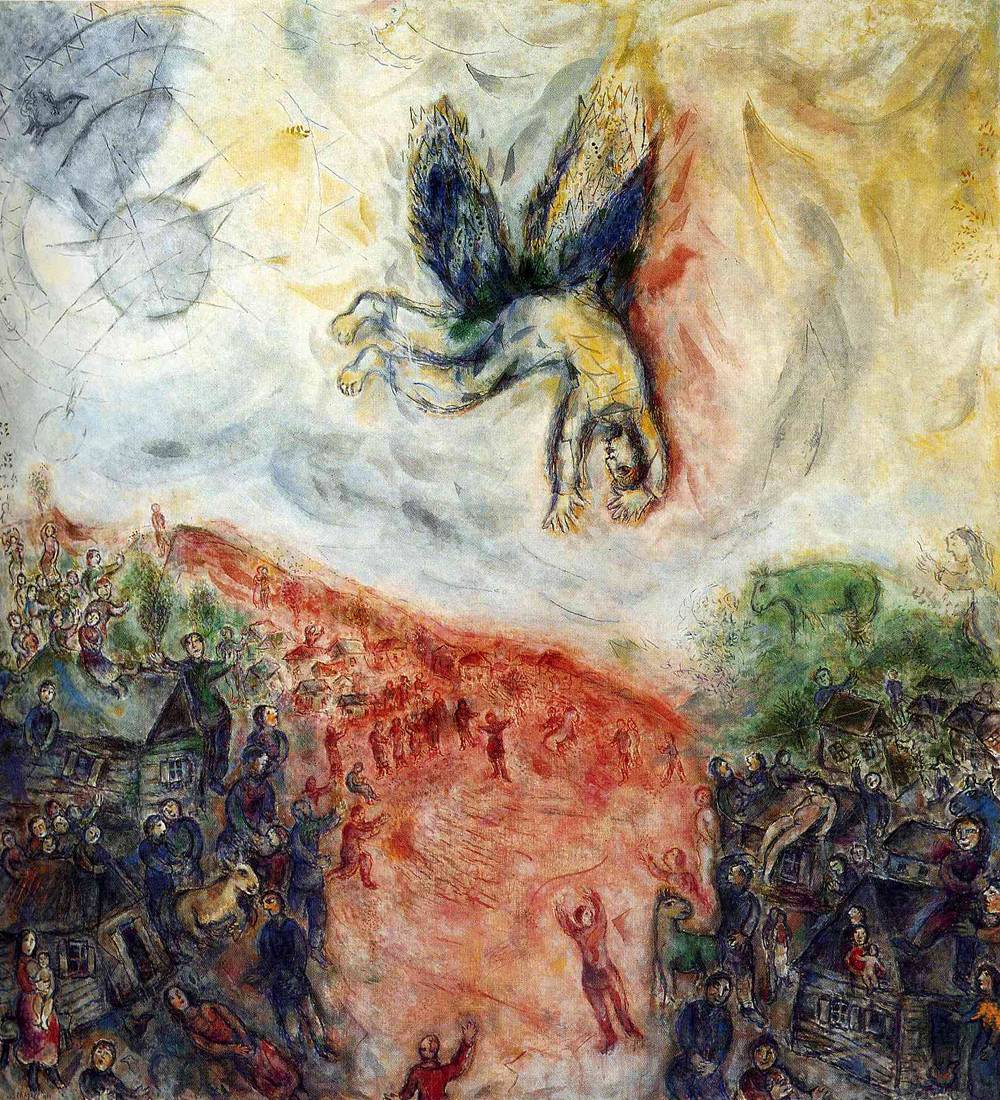
If symbols, such as "The Crucifixion”, recall moments of intense pain, hope always wins. Predominant love, acting as a ground swell, remains the strong symbolism of his work. To those who will accuse him of being naive and smugly innocent, his unwavering popular success will be his most beautiful answer.
By successfully combining contradictions, oppositions and especially differences (reason and supernatural, Judaism and Christianity), Chagall talks about everything to everybody and transforms the boundaries; he wants to be a humanist for his own salvation.
A sincere humanism is instinctively understood by the majority whilst his slavic symbolism is foreign to his western land. Reality transformed by analogies and other magical substitutions will give Chagall’s creation a modernity anchored in traditions responding to expectations of his time.
To transcend his work, Chagall will be a “genius who touches everything”, like Picasso, plural in his creations. Theatre, decoration, illustration, murals and stained glass will be his playgrounds. No matter what the means or supports are, like a tightrope-walker defying the emptiness below him, he will transform his disciplines by re-fitting and re-inventing them, constantly open to the world that surrounds him.
Chagall grants himself all the freedoms he needs. While remaining close to the surrealists, he never makes an allegiance to them but does not reject this relationship. He mixes up chromatic paths, substituting yellow for red, green for blue, reality is for the devil, long live freedom.
Anachronistic and atypical, he is still a lucid observer of his time. He digests, among others, cubism, integrating it into his paintings to give them a three-dimensional effect. These "floating" characters are a suspension of time and space, vertical replaces horizontal: anything goes.
From what could be a huge hotchpotch of ideas comes a balanced masterpiece, touched by grace. He is a great master. Similarly, seduced by the “avant garde”, he never accepts the destruction of the past that this current would like to impose on him, he for whom roots and memories are so important.
A curious observer of his time, an enlightened spectator, he refuses to be shut in and does not compromise with his creative freedom.
The refuge of childhood, the nostalgia of a bygone and sometimes idealised past, is ubiquitous; he wants to be the witness and the guardian of it. Why oppose the past and the present, instead of seeing them as an obvious, peaceful time-line.
He becomes the enemy of ideologies although he has known them all, from Nazi ideology to Marxist ideology. Chagall is a conciliator, too marked with the history of art to forget that everything is a continuum, each era bring a stone to the edifice, taking away the foundations will make the work collapse.
The Master denies idolatry, his symbolism is not to be exploited, it is only one component of his creation and not an end in itself. He wants to be judged by his stroke, his pictorial composition, his style above all, recognisable amongst thousands.
Over time, he completely frees himself of the few artistic influences he has come across to move towards a more instinctive and intuitive creation. A sort of emergency seizes him by a formal simplicity: to remember his childhood, to sleep and dream incessantly. Should we interpret that as a way to escape reality, to escape the human condition. Some will criticise him for this blindness, others will see it as his salvation.
His boundless creativity, his desire to renew the artistic techniques available to him will never be faulted; he is the champion of humanity through his favourite themes of love and celebration, values that are essential to understanding his universal work, they help maintain a more modern hope.