
- Home
- Lifestyle
- The art of living in Provence
- The almond tree, or the white promise of February
The almond tree, or the white promise of February
#almond #tree # #luberon #provence #vaucluse #gordes #gastronomy #cultivation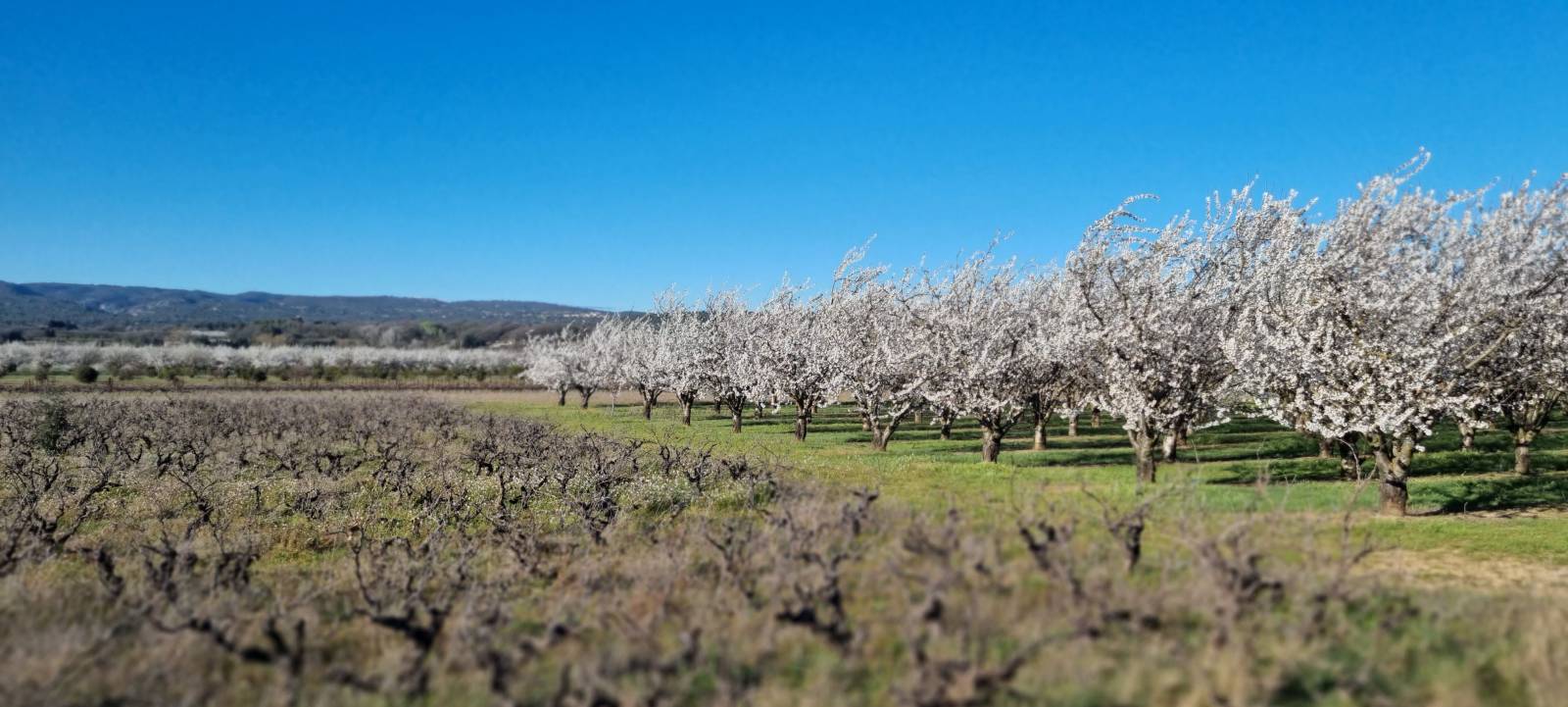
It is six o'clock in the morning in the Luberon hills. The air is still crisp, almost sharp, and the light hesitates between blue and gold. In a field bordered by terraces, a man walks slowly between the rows of almond trees. He stops in front of one of them, looks up at the bare branches already dotted with white flowers, and smiles discreetly.
“Every year, I wonder if they'll dare,” he confides, brushing a branch. “And every year, they dare.”
It is February. Nothing else seems ready to bloom, yet the almond tree has chosen its moment. It does not hide behind the established warmth of spring. It steps forward, fragile and luminous, in an uncertain season. This silent audacity is perhaps what makes it so profoundly Provençal.
On the heights of Gordes, along the paths leading to the Abbey of Notre-Dame de Sénanque, or in the rolling hills surrounding Bonnieux or Vénasque, the almond blossoms transform the landscape into an ephemeral constellation. The golden stones seem softer, the sky vaster. Provence no longer seems to be waiting for spring: it is announcing it.
The tree of austere lands
The almond tree is not demanding. It likes poor, calcareous, sometimes ungrateful soils. Where other crops give up, it takes root. Introduced around the Mediterranean basin in ancient times, it has found a home in Provence, shaped by light and wind.
In the areas around Apt, Saignon, and Vaison-la-Romaine, it was long planted at the edge of fields, on terraces patiently built by hand, or near farmhouses, as a complementary tree that did not encroach on the vines or wheat.
Paul, whose family has been farming this land near Cucuron for three generations, says: “My grandfather used to say that the almond tree doesn't lie. If it flowers, it's because it believes in the season. But if it freezes afterwards, you have to accept the loss. It's a tree that teaches us humility.”
In the 19th century, Provence had millions of almond trees. The September harvest brought families and neighbors together in a precise ballet. Large sheets were spread out on the ground. The branches were carefully shaken. The shells fell in a dry, noisy rain. Then came the time for drying in the sun, shelling, and meticulous sorting.
There was a deliberate slowness to these actions, a transmission without words. The almond tree structured the landscape as much as it shaped memories.
The silence of decline, the momentum of renewal
The 20th century upset this balance. Large foreign farms, particularly American ones, imposed their volumes and prices. The less profitable orchards of Provence were gradually abandoned. The almond trees aged without replacement. Some fields returned to wasteland.
“For years, we left them alone,” recalls Paul. “Then we realized that they were part of us.”
For the past decade, a revival has been taking shape. Producers are choosing to replant, aware that almond trees, which require little water, are well suited to contemporary climate challenges. Old varieties are regaining their place. Landscapes are slowly being redrawn.
Replanting an almond tree means accepting the long term. The tree only really bears fruit after several years. It requires trust and patience. But in return, it offers an almost reassuring stability, a loyalty to the land.
From tree to table
While the almond tree shapes the landscape, the almond shapes the table.
In a bright workshop in L'Isle-sur-la-Sorgue, a pastry chef works with almond paste that is still warm from roasting. The smell is warm and enveloping.
“A local almond doesn't react like a standardized almond,” she explains. “It absorbs sugar differently and retains a delicate crunch. You can taste the earth behind the flavor.”
Sault white nougat owes its character to almonds. Calissons d'Aix owe their melt-in-the-mouth texture to them. Croquants, macarons, and rustic biscuits find their balance in them.
But almonds are not limited to sweet dishes. In a contemporary kitchen near Ménerbes, a chef is revisiting tradition: "I use almonds in sauces to accompany grilled fish, or in a tapenade where they replace some of the olives. It adds roundness and depth. It tells a story beyond salt.
The almond thus becomes a link between heritage and creation. It does not merely illustrate tradition; it inspires innovation.
A day of harvesting
In September, the light changes. It becomes denser, more golden. In Paul's orchard, the husks split open to reveal light beige shells. Harvesting begins early to avoid the heat.
The branches are shaken mechanically or beaten with precision. The fruits fall onto nets spread out on the ground. The sharp sound of the shells echoes like autumn rain.
“It's a special moment,” he says. “We measure the results of an entire year.”
The almonds are then dried, sorted, and sometimes shelled on site. The movement is precise, almost meditative. Fine dust rises underfoot. The sun slowly sets behind the hills.
There is something timeless about this scene.
The tree near the farmhouse
On many old properties in the Luberon, an old almond tree stands guard near the terrace or at the entrance to a driveway. Its gnarled trunk, hollowed out by the years, seems to carry the memory of generations.
At the end of each winter, it still blooms, like a quiet miracle.
Planting an almond tree today is a gesture for the long term. It means accepting that beauty must be earned, that the harvest is not immediate, that nature imposes its own rhythm. In a fast-paced world, the almond tree offers a lesson in consistency. It teaches us to trust in cycles and remain faithful to the seasons.
And when its white flowers bloom against the cold February sky, they remind us that Provence is not just about the splendor of summer. It also lives in those suspended moments when promise precedes certainty.
Thus, the almond tree connects the earth to the table, history to the present, the patient gesture of the farmer to the inspired gesture of the cook. It reminds us that Provence is not just light or scenery, but a way of living in the world with moderation and fidelity.
And every year, when the blossoms light up the hillsides even before spring is assured, the almond tree whispers to us that sometimes we must believe before we see.