
- Home
- Lifestyle
- This month's selection
- “True luxury is the time we take for ourselves.”
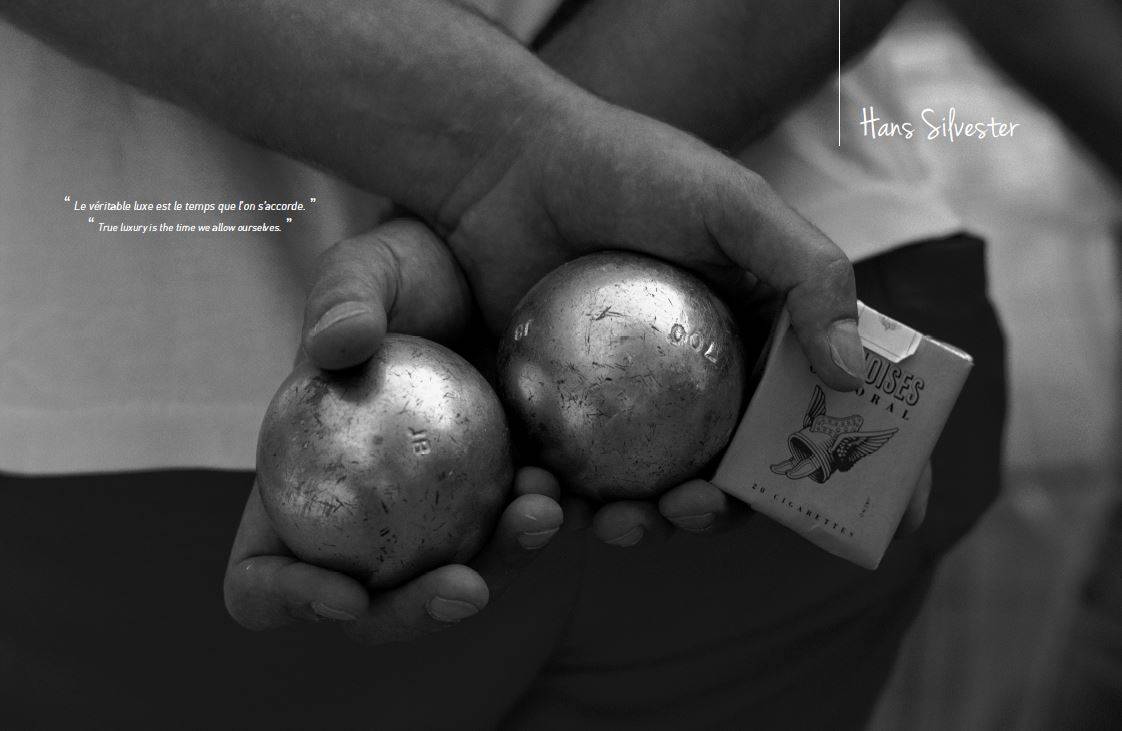
“True luxury is the time we take for ourselves.”
PETANQUE, OR THE ELEGANCE OF TIME REDISCOVERED
by Hans Silvester, photographic memory of Provence
There is, in Provence, a theatre without walls or curtains, a theatre offered to the sky, to light, and to people. The ground is its stage. The plane trees are its wings. And the actors, modest and silent, have always performed the same play there. That play is called pétanque.
In the black-and-white photographs Hans Silvester devoted to this ritual during the 1960s and 1970s, Provence appears in its purest truth. Nothing feels staged. Nothing is artificial. Everything breathes sincerity. The pale dust, the long shadows, the motionless silhouettes create a world where time itself seems to have agreed to slow down.
Pétanque always begins with silence.
A man stands inside the circle. His hand weighs the metal boule. His gaze becomes fixed. Around him, the others wait. They know this moment belongs only to him. There is a form of instinctive respect in this silence.
Then the gesture emerges. Slowly. Naturally. As though it had always existed. And when the boule leaves the hand, it carries far more than intention. It carries part of the man who threw it.
Because pétanque is never merely a game. It is a confrontation. A confrontation with oneself.
THE GAME AS A MEASURE OF MAN
Pétanque possesses the rare ability to reveal people as they truly are. One only has to observe them. Some step into the circle with confidence, almost with pride. Others enter cautiously, as though afraid of disturbing the invisible balance of the place.
That circle drawn in the dust is more than a boundary. It is a space of truth.
The game appears simple: place one boule closer to the jack than your opponent’s. Yet this simplicity is deceptive. Every throw contains a choice. To attack or wait. To dare or restrain oneself. To risk or preserve.
Very quickly, the player understands that willpower alone is not enough. The terrain has its own law. An invisible pebble may alter a trajectory. A tiny imperfection may turn success into failure.
And so he learns. He learns humility. He learns acceptance. He learns to begin again. What matters is not so much the result as the manner. The way one remains dignified in clumsiness. The way one remains simple in success.
Pétanque thus becomes an inner school. It tempers impatience. It calms pride. It teaches balance.
PROVENCE AS A SETTING
In the villages of the Luberon, pétanque belongs to the landscape itself. In Gordes, as the sun declines behind golden stone façades, village squares come alive with a gentle rhythm. In Ménerbes, Bonnieux, and Oppède, the same gestures have been repeated for generations.
Nothing has changed. And perhaps that is the most precious thing of all. Provence offers pétanque its light. It offers its slowness. It offers its eternity.
Hans Silvester’s photographs bear witness to this perfect harmony. They reveal a Provence without artifice. A lived-in Provence. A deeply inhabited Provence.
The men he photographs do not pose. They simply are. And that simplicity becomes a form of greatness.
THE BEAUTY OF SIMPLE GESTURES
Hans Silvester possesses the rare eye that recognizes what truly matters. His photographs do not seek performance. They seek truth.
The hands he photographs bear the marks of work, time, and life. The faces are serious or peaceful. The gazes are fixed upon an invisible point.
These men are playing, but they are also meditating. They do not seek to conquer. They seek precision. That exact point where the gesture becomes true.
Pétanque then becomes a metaphor for existence itself. Each man throws his boules as he moves through life. With hope. With doubt. With courage. And with that measure of uncertainty one must learn to accept.
TIME REDISCOVERED
In a world that never stops accelerating, pétanque remains a refuge. It imposes another rhythm. It imposes slowness. It imposes presence. One cannot play while thinking elsewhere. One must be entirely there.
And that presence is a form of wealth. Perhaps even the greatest wealth of all. Because true luxury is not what one owns. It is the time one fully inhabits.
In Provence, that luxury still exists. It can be found at the end of an afternoon. In the shade of a plane tree. In the muted sound of a boule striking the earth.
HANS SILVESTER, THE WITNESS
When Hans Silvester settled in Provence in the early 1960s, he immediately understood that he had discovered a unique land.
Born in Germany in 1938, he discovered photography early as a way of understanding the world. But it was here, in southern France, that his vision fully matured.
Pétanque became one of his first major subjects. He photographed without interrupting. Without directing. Without transforming. He waited. And what he captured transcended simple documentary. His images became memory itself.
Later, he travelled the world — Africa, India, South America — always photographing people with the same attentive gaze. Yet Provence remained one of his deepest anchor points.
Today, his pétanque photographs are among the most precious testimonies to this Provençal art of living.
THE PROVENÇAL ART OF LIVING
In Provence, pétanque naturally finds its place within properties and gardens. It accompanies homes. It extends terraces. It gathers friends together.
At ROSIER Agency, this art of living is an integral part of the identity of the places we represent. These homes are not merely architecture. They are spaces designed to welcome life itself. A terrace. A garden. A pétanque court…
And the time that unfolds within them. Because pétanque is not a detail. It is a symbol. The symbol of freedom. The freedom to take one’s time. The freedom to share. The freedom simply to be.
PROVENÇAL ETERNITY
Even today, the same scenes continue to exist. The same gestures. The same silences. The same gazes. Hans Silvester captured them forever. And within his images, Provence continues to breathe.
Pétanque remains what it has always been: a way of being in the world. A way of inhabiting time. A way of living.
“In Provence, pétanque is not a game. It is the living memory of time.”
Credits
Text inspired by Ayvan Audouard’s book Pétanque et Jeu Provençal
Photographs by Hans Silvester